
/projects · side project · 2026
Decoding the pictures of the Voyager Golden Record
In 1977 two spacecraft left Earth carrying 116 pictures recorded as sound on a gold-plated record. Out of curiosity, I decoded them again from the original master-tape transfer, treating it the way we treat any tape transfer at the lab: measure the timing, the levels and the faults, then correct them.
The record
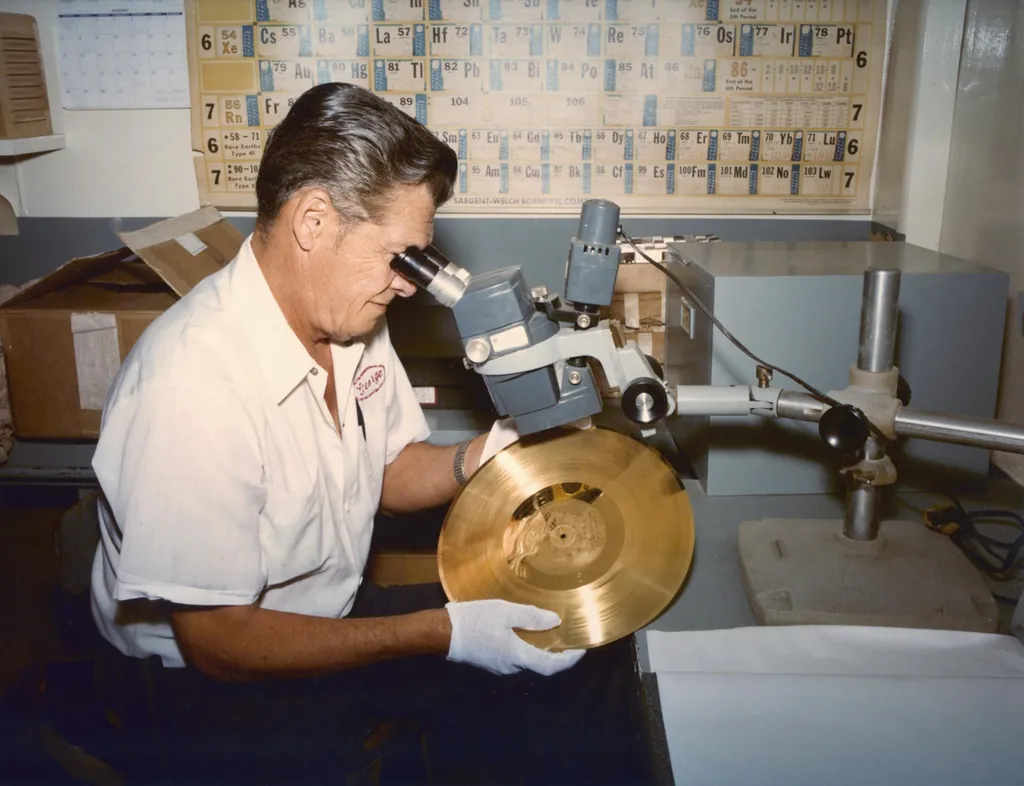
Voyager 2 and Voyager 1 were launched in August and September 1977 to explore the outer planets. Both have since left the Sun's neighbourhood and are travelling through interstellar space. Fixed to the side of each spacecraft is a 12-inch gold-plated copper phonograph record: a message for whoever, or whatever, might one day find it.
The contents were chosen for NASA in less than a year by a committee chaired by Carl Sagan of Cornell University: Frank Drake as technical director, Ann Druyan as creative director, Timothy Ferris as producer, Jon Lomberg as design director and Linda Salzman Sagan organising the greetings. The record carries spoken greetings in 55 languages, a sound essay of the Earth (wind, rain, animals, footsteps, a heartbeat, a kiss), 90 minutes of music from many cultures and periods, and 116 pictures.
The record is meant to be played at 16⅔ rpm, with the cartridge and stylus included with it. Its aluminium cover is engraved with instructions: how to play it, how fast it should turn (measured in a unit of time taken from the hydrogen atom) and how to turn the picture signal back into images.
Pictures recorded as sound
Putting pictures on a phonograph record was Frank Drake's idea. The difficulty was finding a machine that could do it. His colleague Valentin Boriakoff found it in an electronics catalogue: Colorado Video, a small television equipment company in Boulder, had built a device to send still television images over telephone lines as audio. Its engineers donated their time to the project: each slide was projected onto a television camera and converted into a few seconds of sound. The sound was recorded on a Honeywell 5600-C instrumentation tape recorder lent by its manufacturer. When President Carter's message and a list of members of Congress arrived at the last minute, the recorder had to be flown back to Boulder for a second session, with a seat booked on the plane for "Mr. Equipment", as Carl Sagan tells it.
Each picture is drawn as 512 vertical lines of about 8 milliseconds each, like television turned on its side. Every line starts with a short sync pulse; what follows is the brightness down the line. Colour pictures were sent as three separate pictures of the same scene, one per colour.
In 2017, for the 40th anniversary, Ozma Records (David Pescovitz, Timothy Daly and Lawrence Azerrad) released the Golden Record on vinyl for the first time. The original reels were transferred at Sony Archives, and Bernie Grundman remastered the music and greetings with Timothy Ferris. The edition won the 2018 Grammy for Best Boxed or Special Limited Edition Package. That year David Pescovitz also shared a high-resolution transfer of the picture section with Ron Barry, who published the first public account of decoding the pictures by following the instructions on the cover. That transfer, 384 kHz and 32-bit, is what I worked from.
A tape-transfer problem
Most decoders cut the signal into lines of a fixed length. That works, but it assumes the tape ran at a perfectly constant speed in 1977 and again during the transfer. Any speed error then bends lines that should be straight, and other faults of an analogue chain stay in the pictures. Looked at as a tape transfer, the recording has a lot to say.
Timing, line by line
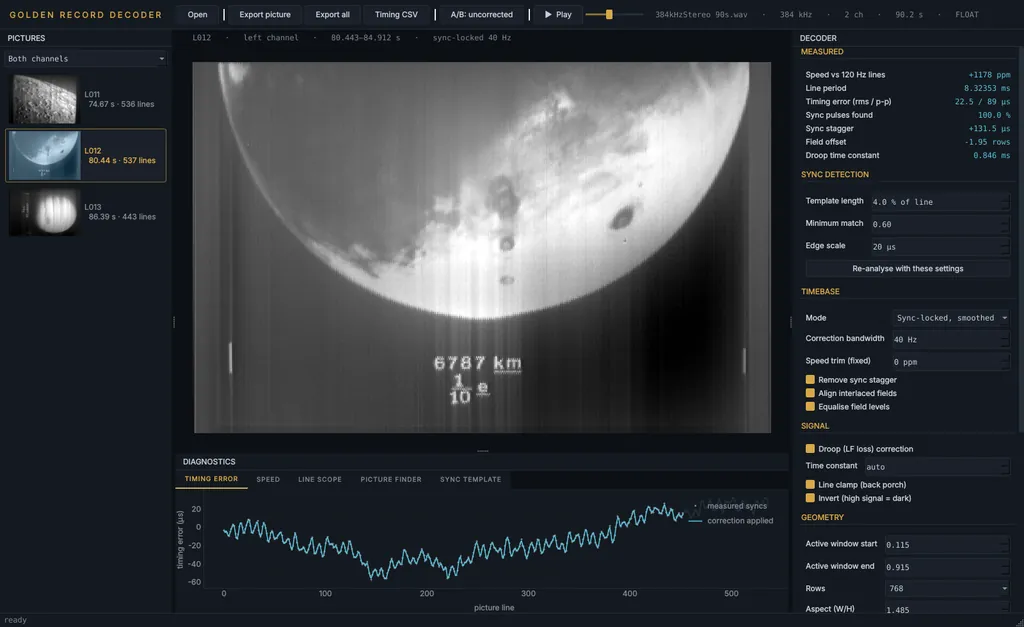
Every line starts with a sync pulse, and each pulse is a timing reference recorded together with the picture. The decoder locates each one to a fraction of a sample and compares it with where a constant-speed machine would have put it. Across the first 25 pictures the timing error is typically ±50 µs, up to 210 µs peak to peak within one picture: wow, plus flutter at around 13 Hz on some pictures. The decoder turns the measured pulses into a smooth time axis (correction bandwidth 40 Hz, against a line rate of 120 Hz), so speed errors are corrected even inside each line.
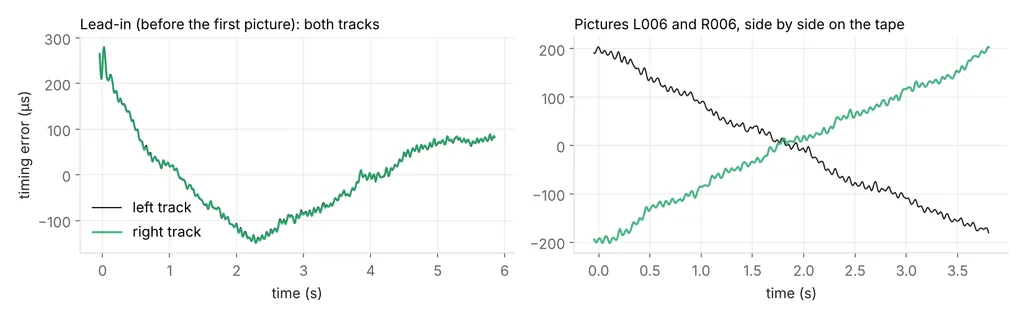
Both tracks pass the replay head at the same moment, so anything the replay machine does shows up identically on both. The lead-in before the first picture confirms it: there, the two tracks carry the same timing error to within 1.5 µs, which also rules out any significant azimuth wobble between them. The pictures behave differently. Two pictures lying side by side on the tape run at speeds that differ by up to 200 parts per million, the difference changes from one pair to the next, and their flutter is largely independent. The two tracks were evidently not recorded together: the pictures seem to have been laid down on each track separately, probably one take at a time, each with its own speed and wow. Only the sync pulses, recorded together with the pictures, can remove those errors.
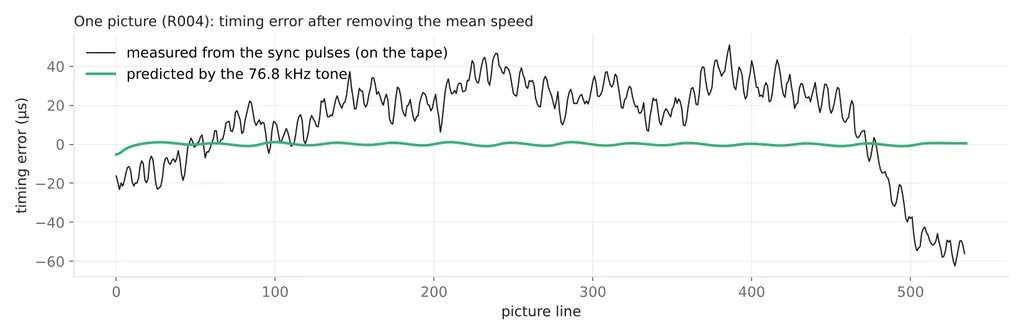
The transfer also carries a faint steady tone at 76.8 kHz. I first hoped it was a pilot recorded on the tape that could be used to correct wow and flutter. Measured, it holds its frequency to about one part per million while the tape wanders by hundreds, and it does not follow the timing of the sync pulses at all, so it was added by the transfer chain, not the tape.
The staggered sync
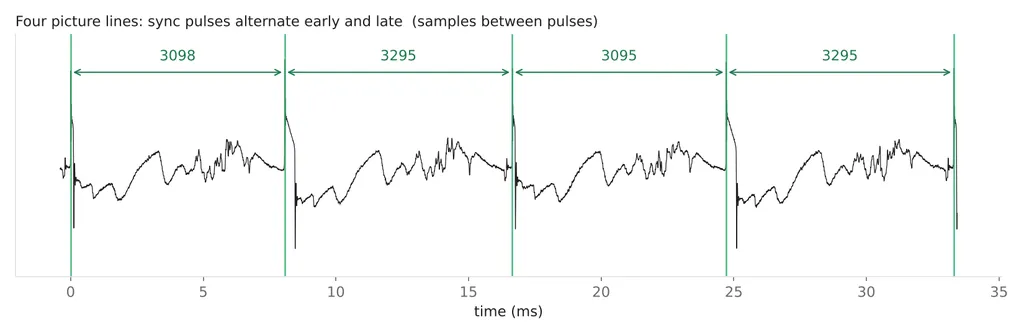
The record cover draws the picture lines with a "staggered interlace". On the tape this shows up in a way I have not seen described: the sync pulses alternate early and late by 131 µs, so the intervals between them alternate between about 3,300 and 3,100 samples, while the picture itself sits on an even grid. The two kinds of line also start with differently shaped pulses. The decoder moves the pulses back onto the grid, after which the two interlaced fields line up, and evens out their brightness, which removes fine vertical striping.
Low-frequency loss
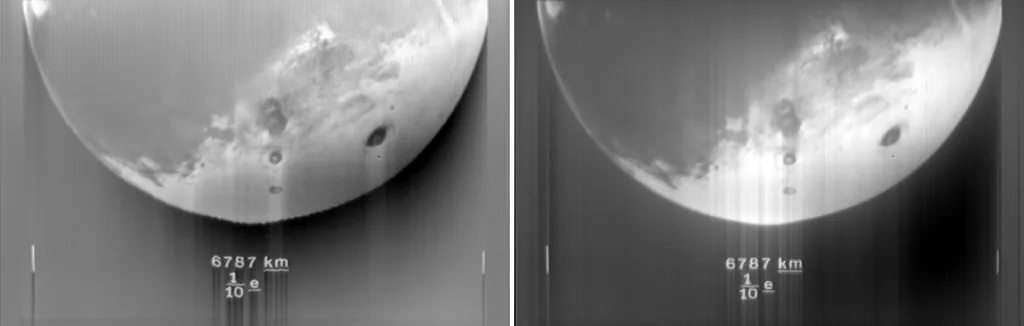
The recording chain was AC-coupled: after every large change in brightness the signal sags back towards zero with a time constant of about a millisecond. In the pictures this leaves dark shadows under bright objects, light halos and shading down every line. The decoder measures that time constant on the flat tops of the sync pulses (0.8 ms on the left channel, 0.5 ms on the right) and applies the exact inverse filter.
The pictures
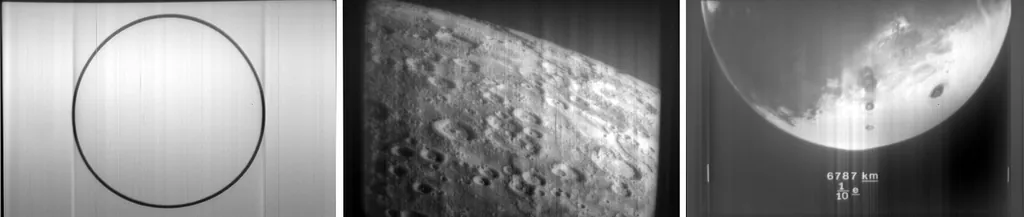
The pictures come out in the order they were recorded: the calibration circle, then Frank Drake's pages of mathematical and physical definitions, the solar system and its planets, and then life on Earth. Most of them are the work of individual photographers and artists, who hold the rights to them, so only a few are shown here: Jon Lomberg's calibration circle, with his kind permission, and NASA's images of the planets.
The decoder
The decoder was written by Claude, Anthropic's AI. I set out what it should do, asked the questions, made the measurements and did the listening, and checked the results; all of the code is Claude's. The program finds the pictures by itself, locks to every sync pulse, applies the corrections above, calibrates the aspect ratio on the circle in the first picture and recognises the colour pictures. It can also play the recording while the picture is drawn line by line in step with the sound, which is the closest I can get to hearing what the record's recipients would hear. The program (Windows) and its source code are free and open source on GitHub, under the MIT licence.
Credits
- Voyager Golden Record (1977): Carl Sagan (chair), Frank Drake (technical director), Ann Druyan (creative director), Timothy Ferris (producer), Jon Lomberg (design director), Linda Salzman Sagan (greetings), for NASA and the Jet Propulsion Laboratory.
- Picture encoding: Frank Drake, Valentin Boriakoff and the engineers of Colorado Video, Inc.
- 40th-anniversary edition: Ozma Records - David Pescovitz, Timothy Daly, Lawrence Azerrad - with Timothy Ferris. Transfer of the master reels: Sony Archives. Remastering of the music and greetings: Bernie Grundman.
- First public decoding (2017): Ron Barry.
- Analysis and decoding: Carlos Nascimento, Qualia Audio Lab. Decoder code: Claude (Anthropic).
Further reading
- Golden Record Decoder on GitHub: the program, its source code and a detailed technical description of how it works.
- Carl Sagan, Frank Drake, Ann Druyan, Timothy Ferris, Jon Lomberg, Linda Salzman Sagan, Murmurs of Earth: The Voyager Interstellar Record (1978), the story of the record by the people who made it.
- NASA: The Golden Record cover, with an explanation of the engraved instructions.
- NASA: The Making of the Voyager Golden Record, a gallery of photographs from the production of the record in 1977.
- Carl Sagan, draft of the first chapter of Murmurs of Earth (January 1978), Library of Congress.
- Ron Barry, How I decoded the images on the Voyager Golden Record, Boing Boing, 2017.